- عربي
- 中文
- English
- Français
- Русский
- Español


High-Level Panel Discussion Explores the Role and Evolution of Independent Oversight in the United Nations System
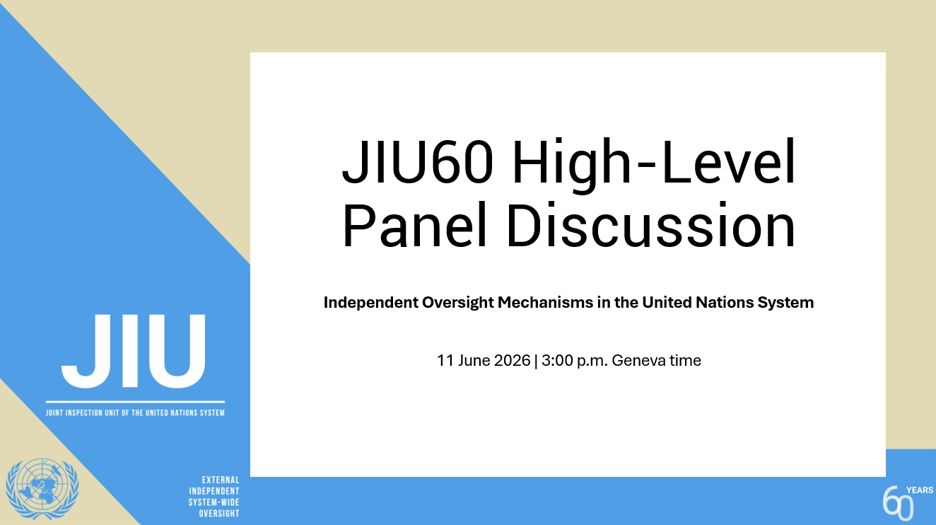
Geneva, 11 June 2026 - As part of the Joint Inspection Unit's (JIU) 60th anniversary commemorations, the JIU convened a High-Level Panel Discussion on "Independent Oversight Mechanisms in the United Nations System", bringing together senior oversight leaders from across the United Nations system to discuss the role of independent oversight in strengthening accountability, transparency, organizational learning and institutional effectiveness.
The event attracted 212 participants from across the United Nations system, Member States, oversight bodies, governing bodies and partner organizations.
The discussion featured:
- Conrod Hunte, Chair, Joint Inspection Unit (JIU);
- Fatoumata Ndiaye, Under-Secretary-General, Office of Internal Oversight Services (OIOS);
- Richard Bellin, Director of External Audit, United Nations Board of Auditors (BOA);
The event was moderated by Mika Tapio, Executive Secretary of the Joint Inspection Unit.
Opening remarks were delivered by Catherine Pollard, Under-Secretary-General for Management Strategy, Policy and Compliance, speaking on behalf of the Secretary-General.
The panel explored the role of oversight in the United Nations system, the complementarity of different oversight functions, the importance of independence and adequate resourcing, coordination among oversight actors and the contribution of oversight to institutional learning, accountability and ongoing reform efforts, including the UN80 initiative.
Oversight as a Strategic Enabler
A central message emerging from the discussion was that oversight should not be viewed solely as a compliance or control function. Panelists emphasized that effective oversight serves as a strategic enabler that supports organizational learning, strengthens governance, promotes transparency and helps organizations improve performance and achieve better results. In an increasingly complex operating environment characterized by financial constraints, reform pressures and emerging risks, oversight plays a critical role in helping organizations adapt while maintaining the confidence of Member States and other stakeholders.
A Complementary Oversight Architecture
The discussion highlighted that oversight in the United Nations system is not the responsibility of a single institution. Rather, it is delivered through a complementary architecture comprising:
- Internal oversight functions, including OIOS and similar offices across the UN system;
- External audit functions, including the Board of Auditors and other external audit arrangements;
- Independent system-wide oversight through the Joint Inspection Unit.
Panelists emphasized that these functions are distinct but mutually reinforcing, each contributing a unique perspective to the broader accountability framework.
Independence Remains Fundamental
The discussion reaffirmed that independence remains the cornerstone of credible oversight. Panelists highlighted the importance of maintaining:
- Structural independence;
- Operational independence;
- Professional independence;
- Financial independence.
At the same time, independence was described as being fully compatible with engagement and dialogue. Effective oversight is not about isolation and hiding behind independence; rather, it requires constructive interaction with management, governing bodies and stakeholders while maintaining objectivity, impartiality and professional rigour.
Coordination Strengthens Impact
Panelists underscored that OIOS, the Board of Auditors and the JIU operate as part of an intentionally designed system, each with distinct mandates and roles. However, within this framework, coordination among the oversight actors is essential to maximize value and reduce unnecessary burden on organizations. Examples discussed included:
- Regular tripartite oversight coordination meetings between the three offices;
- Information-sharing on work plans and emerging risks;
- Risk-based planning and prioritization;
- Reliance on previous oversight work where appropriate.
The JIU also highlighted its annual consultation process with participating organizations to identify and assess potential topics for its programme of work, helping ensure that reviews address issues of greatest relevance, utility and strategic importance.
Supporting Reform and UN80
The discussion also explored how oversight can contribute to ongoing reform efforts, including the UN80 initiative. Panelists noted that oversight can help identify opportunities for:
- Governance reform;
- Shared services;
- Greater harmonization across organizations;
- Improved risk management;
- Organizational transformation;
- Efficiency and effectiveness gains.
The JIU emphasized that many of these themes have been examined through previous system-wide reviews and that oversight can provide valuable evidence and lessons learned to support future reform efforts.
Emerging Challenges for Oversight
Looking ahead, panelists identified digital transformation and artificial intelligence as major areas that will shape the future of oversight. Among the issues discussed were:
- New audit, evaluation and review methodologies;
- Development of specialized expertise;
- Governance and accountability frameworks for artificial intelligence;
- Responsible use of emerging technologies within oversight functions.
Panelists agreed that oversight bodies themselves must continue evolving to remain relevant and effective in rapidly changing environments.
Engaged Audience Participation
The panel generated a lively exchange with participants through an extensive Q&A session. Questions focused on a range of topics, including:
- Oversight fatigue and assurance mapping;
- The role of audit and oversight committees;
- Gender equality and victim-centred approaches in oversight work;
- Independence and resourcing of oversight functions;
- Oversight support for organizational reform and transformation.
Participants emphasized the importance of maintaining strong oversight arrangements while ensuring coordination, proportionality and effective use of limited resources.
Looking Ahead
As the United Nations navigates reform, financial pressures and increasingly complex global challenges, the discussion reaffirmed that independent, coordinated and complementary independent oversight remains essential to strengthening trust, improving performance and supporting the effectiveness of multilateral institutions.
Resources
Key messages from the discussion
Learn More
JIU Recommendation Tracking System
For additional post-event content, including selected questions and answers from the discussion and further reflections on the future of oversight in the United Nations system, follow the JIU on LinkedIn, visit the JIU website and subscribe to the JIU communication mailing list (jiucommunications@un.org).